
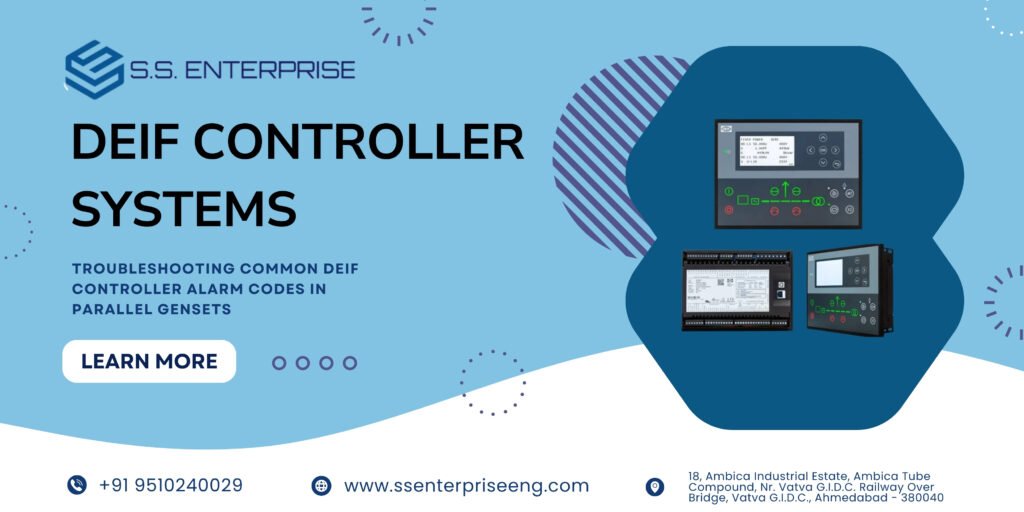
Operating multiple diesel generators in parallel provides industrial plants and commercial facilities with robust, scalable, and uninterrupted power. At the heart of these complex systems are advanced controllers—such as DEIF controllers—which manage load sharing, frequency matching, and automatic synchronization.
However, even the most reliable systems can occasionally trigger alarms or protective shutdowns. When an alarm sounds, time is critical. Understanding what these error codes mean and knowing how to troubleshoot them safely prevents prolonged plant shutdowns and protects expensive electrical assets.
1. Why DEIF Controller Alarms Occur in Synchronized Systems
DEIF controllers are engineered with high-precision monitoring parameters. They constantly track busbar voltage, generator frequency, phase angles, and power output. When a parameter drifts outside of safe operational thresholds, the controller triggers an alarm or trips the breaker to safeguard the alternator and connected equipment.
Most alarms fall into three primary categories:
Voltage & Frequency Faults: Deviations from standard operating bands (e.g., over-voltage, under-frequency).
Synchronization & Phase Mismatch: Issues during breaker closure due to phase angle drift.
Reverse Power & Load Sharing Faults: Imbalances in active power distribution across parallel units.
2. Step-by-Step Diagnostic Workflow for Common DEIF Alarms
A. Over-Frequency and Under-Frequency Trips
The Symptom: The controller flashes an over-speed or under-speed alarm, causing the genset to drop off the busbar.
Root Cause: Governor response lag, fuel supply fluctuations, or incorrect frequency setpoints in the controller configuration.
Troubleshooting Steps:
Check the governor actuator and linkage for mechanical wear or sluggish response.
Verify if the frequency droop settings match across all parallel generators.
Inspect fuel filters and injectors to ensure consistent fuel delivery under varying load conditions.
B. Reverse Power Protection Alarms
The Symptom: A reverse power trip disconnects one of the running generators suddenly, shifting the entire electrical burden onto the remaining units.
Root Cause: A generator motoring instead of generating power, often caused by a sudden drop in engine prime mover power while still connected to the live bus.
Troubleshooting Steps:
Review fuel supply and engine performance parameters for the tripped unit.
Inspect the kW transducer or internal power measurement calibration on the controller.
Ensure that active power sharing configurations are balanced correctly among all units in your DG Synchronize Panel.
C. Sync-Check Failures (Phase Angle Mismatch)
The Symptom: The breaker refuses to close, or a sync-check alarm activates during parallel startup.
Root Cause: The phase angle, voltage difference, or slip frequency exceeds the permitted window programmed into the system.
Troubleshooting Steps:
Verify the phase rotation sequence across all alternators using a standard rotation meter.
Check the AVR settings for voltage hunting or instability that prevents the voltage delta from settling within limits.
Fine-tune the controller’s synchronizing parameters (such as phase window degrees and slip frequency timer). For precise integration, pairing your system with a high-grade Synchronize Relay ensures tight phase matching.
3. Preventive Best Practices to Minimize Controller Faults
Routine maintenance significantly reduces the frequency of unexpected controller trips:
Firmware and Parameter Backups: Regularly export and back up your DEIF controller configurations so settings can be restored quickly after maintenance.
Clean Signal Wiring: Ensure communication cables (such as CAN bus lines) are shielded properly and routed away from high-voltage power cables to prevent electromagnetic interference (EMI) errors.
Regular Battery Health Checks: Low control-circuit voltage can cause erratic controller behavior and false alarms. Maintain stable DC power supply inputs across all Power Control Panels.
Summary
Quickly diagnosing DEIF controller error codes keeps your backup power infrastructure resilient and dependable. Whether you are fine-tuning active power sharing or upgrading your system components, utilizing reliable hardware ensures long-term operational stability.
Explore our range of advanced DEIF Controller Systems engineered for seamless multi-genset synchronization and maximum plant uptime.