
When industrial plants, commercial complexes, and mission-critical facilities invest in backup power systems, facility managers often face a major architectural choice: Should we install one massive diesel generator, or should we deploy multiple smaller generators tied together via a synchronization panel?
While a single large generator might seem simpler at first glance, a multi-genset setup governed by an advanced synchronization system offers overwhelming long-term financial, operational, and reliability advantages.
Exploring why DG synchronization panels are significantly more cost-effective helps business owners and plant engineers make smarter capital expenditure decisions.
1. The Fuel Efficiency Trap of Single Large Generators
Diesel generators operate at peak fuel efficiency when loaded between 60% and 80% of their rated capacity.
The Problem with Oversized Single Units: To accommodate future plant expansions, facility managers often purchase a massive single generator. However, during low-demand shifts, night operations, or initial startup phases, that large generator might run at only 15% to 20% load. Operating a diesel engine under-loaded leads to wet stacking (unburnt fuel accumulation in the exhaust), excessive carbon buildup, and plummeting fuel efficiency.
The Modular Multi-Genset Advantage: With a DG Synchronize Panel, you can run smaller generators in parallel. If plant load drops during off-peak hours, the system automatically shuts down unneeded generators, keeping the active units running at an optimal 70% load factor, saving thousands of liters in fuel costs annually.
2. Redundancy and Zero Single-Point-of-Failure
Reliability is the ultimate currency in industrial manufacturing.
The Single Generator Risk: If your facility relies on one massive generator and its engine or alternator fails, your entire plant faces a total blackout until repairs are completed.
The Multi-Genset Solution: In a synchronized configuration utilizing multiple units (e.g., three 500kVA generators instead of one 1500kVA behemoth), if one unit undergoes routine maintenance or encounters a fault, the remaining generators automatically increase output to shoulder the critical load. Production continues without a single second of downtime.
3. Maintenance Flexibility and Lifespan Extension
Easier Servicing: Servicing a massive industrial engine often requires specialized heavy lifting equipment and prolonged plant shutdowns. Smaller parallel engines are easier to service, and replacement parts are more readily available.
Balanced Engine Wear: An intelligent synchronization controller rotates operating hours across all parallel units evenly, preventing premature wear on a single engine and extending the overall lifespan of your backup power assets.
4. Best Practices for Implementing Multi-Genset Systems
Precise Load Sharing: Ensure your synchronization setup features high-grade controls to divide active power cleanly across engines. Explore our advanced Automatic Load Sharing Relay and precision Synchronize Relay options to see how professional integration guarantees stability.
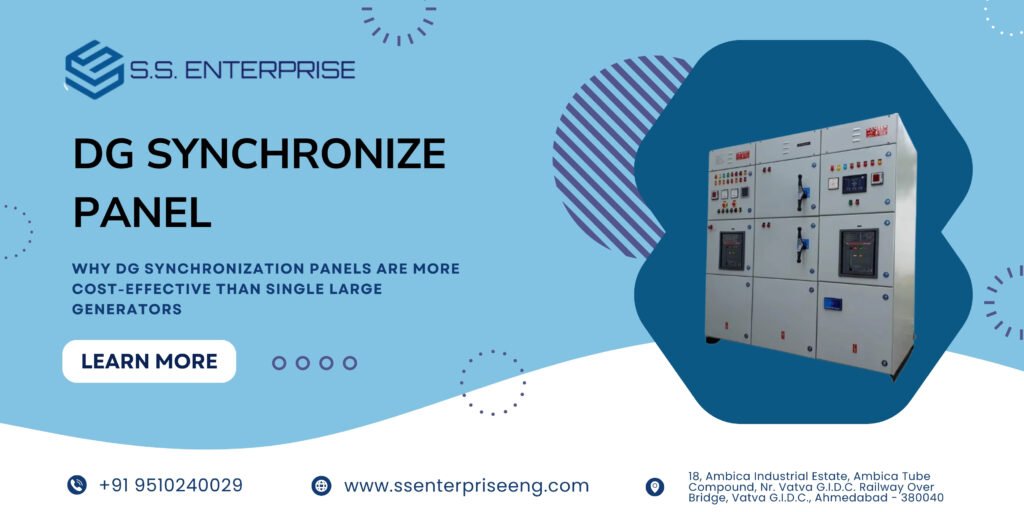
Robust Switchgear Housing: Protect your multi-engine control infrastructure within rugged, custom-engineered enclosures. Explore our specialized DG Synchronize Panel and custom Power Control Panels designed for heavy industrial environments.
Summary
DG synchronization panels transform backup power from a rigid, fuel-wasting expense into a flexible, highly efficient, and fault-tolerant power network. Investing in modular synchronization delivers superior long-term ROI.
Upgrade your facility’s power infrastructure with our custom-engineered DG Synchronize Panel solutions and robust Power Distribution Systems.