
In any industrial power distribution network, massive amounts of electrical energy course through busbars, transformers, and cables every second. While normal operations run smoothly, electrical faults—such as short circuits, phase imbalances, insulation failures, and lightning surges—can occur unexpectedly.
When a fault strikes, the system must be isolated in milliseconds to prevent catastrophic fires, equipment destruction, and injury to personnel. The unsung heroes guarding this infrastructure are Protection Relays.
Understanding the function, types, and integration of protection relays is vital for any switchgear designer or panel builder.
1. What Is a Protection Relay and How Does It Work?
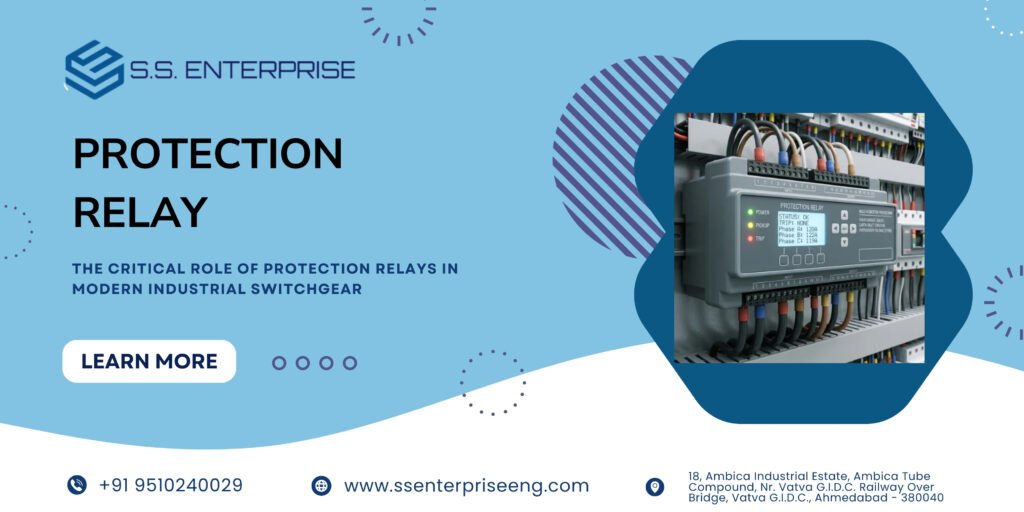
A protection relay is an intelligent monitoring device that continuously measures electrical parameters (current, voltage, frequency, or phase angle) from instrument transformers (CTs and PTs).
Unlike a simple circuit breaker that only opens or closes a circuit, the protection relay acts as the “brain.” It constantly analyzes incoming data against pre-set threshold limits. The moment it detects an abnormal condition or fault, it calculates the severity and sends an instantaneous trip signal to the circuit breaker’s shunt trip coil, isolating the faulty section of the network within milliseconds.
2. Key Types of Protection Relays Used in LT Panels
Modern industrial control panels utilize a variety of specialized protection relays to guard against specific electrical hazards:
A. Overcurrent and Earth Fault Relays (ANSI 50/51 & 50N/51N)
The most common relays in any industrial panel. They protect motors, transformers, and feeders from excessive current draws:
Instantaneous Overcurrent (50): Triggers immediately if current exceeds a dangerous threshold (such as a direct short-circuit).
Definite/Inverse Time Overcurrent (51): Allows brief, harmless overloads (like motor starting surges) but trips if high current persists beyond a safe duration.
Earth Fault Protection (50N/51N): Detects leakage current flowing to the ground or panel frame, preventing dangerous touch voltages and electrical fires.
B. Under-Voltage and Over-Voltage Relays (ANSI 27 / 59)
Industrial machinery is sensitive to voltage fluctuations. Low voltage can cause motors to overheat and stall, while high voltage damages sensitive electronics. Voltage protection relays trip or alarm when grid or generator voltage steps outside safe operational windows.
C. Phase Failure and Phase Sequence Relays
Crucial for three-phase motor protection. If a phase drops (single-phasing) or phase rotation gets reversed due to utility line maintenance, this relay locks out the system instantly to prevent backward motor rotation and burnout.
3. Best Practices for Panel Builders and Plant Engineers
Coordinate Your Relay Settings: Ensure proper time-current coordination between upstream and downstream relays so that only the protective device closest to the fault trips, keeping the rest of the plant running (selective tripping).
Integrate with Quality Switchgear: Pair your safety relays with robust enclosures and busbar systems. Explore our custom-engineered Power Control Panels and advanced Power Distribution Systems to see how reliable protection architecture is built.
Summary
Protection relays are the critical first line of defense in industrial electrical networks. By isolating faults swiftly, they protect expensive capital equipment, eliminate electrical fire risks, and ensure continuous plant safety.
Safeguard your industrial infrastructure with our high-grade Power Control Panels and robust Power Distribution Systems.