
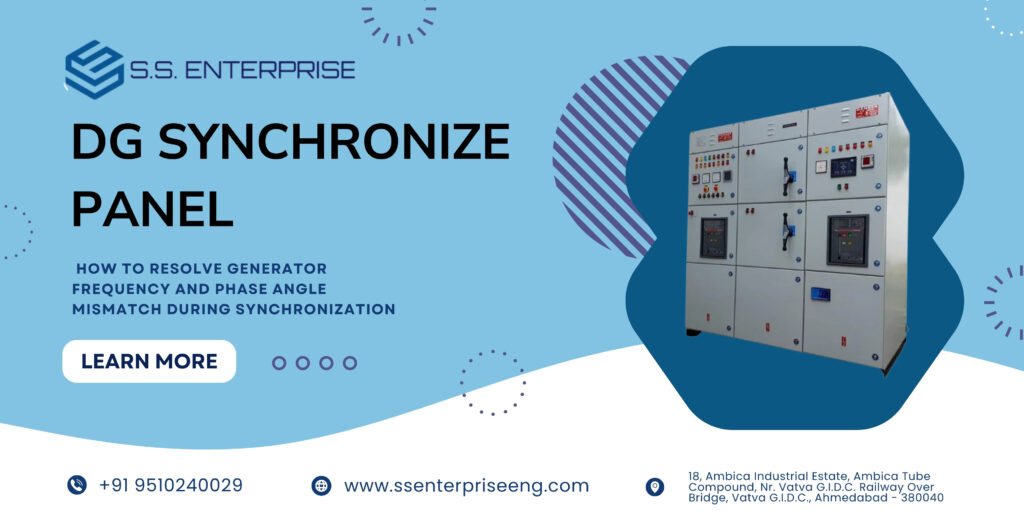
Running multiple diesel generators in parallel requires absolute precision. Before a circuit breaker closes to connect an incoming generator to a live busbar, the system must verify that three critical parameters match perfectly: voltage, frequency, and phase angle.
When a generator suffers from frequency drift or a phase angle mismatch, the synchronization controller or relay will block breaker closure to prevent severe mechanical shock, high transient currents, and potential alternator damage.
Understanding the root causes of these mismatches helps panel builders, operators, and maintenance engineers resolve synchronization failures quickly.
1. The Critical Role of Frequency and Phase Matching
Synchronization is the process of matching an incoming generator’s electrical waveform with the existing busbar waveform.
Frequency Match: Both the bus and the incoming generator must run at the exact same speed (e.g., exactly 50.0 Hz or 60.0 Hz). Even a minor frequency difference creates a “slip frequency” that dictates how fast the phase angle rotates.
Phase Angle Match: The peaks and zero-crossings of the sine waves must align (phase difference near 0 degrees) at the exact moment the breaker command is issued.
If either parameter drifts outside the programmed tolerance window, synchronization stalls.
2. Common Causes of Frequency Drift During Parallel Startup
Frequency instability usually stems from the engine’s prime mover (governor) rather than the alternator itself.
Governor Response Lag: Electronic or mechanical governors that react too slowly to load changes can cause the engine speed to hunt, leading to continuous frequency fluctuations.
Unbalanced Fuel Delivery: Inconsistent fuel injection or dirty fuel filters cause micro-fluctuations in engine RPM, making it impossible for the controller to lock onto a stable frequency.
Droop vs. Isochronous Mode Conflicts: If multiple generators running in parallel are configured incorrectly with conflicting speed-droop settings, they will fight for frequency control, creating persistent drift.
3. Troubleshooting and Resolving Phase Angle Mismatches
When the phase angle fails to settle within the permissible window (typically set between 2 to 5 degrees), check the following areas:
Step 1: Verify Phase Rotation Sequence
An incorrect physical wiring sequence (such as reversing Red and Yellow phases between the alternator output and the busbar) will cause the phase angle to rotate continuously without ever locking. Always verify phase rotation using a digital rotation meter during initial commissioning.
Step 2: Fine-Tune the Governor and AVR Interaction
Voltage fluctuations directly affect active and reactive power sharing, which in turn influences frequency stability. Ensure that your Digital AVR is delivering steady excitation voltage so that terminal voltage remains completely stable while the governor adjusts engine speed.
Step 3: Calibrate the Sync-Check Window Parameters
Sometimes the issue is not physical, but rather an overly aggressive configuration in the control system. Review your synchronization relay settings:
Adjust the phase window slightly if transient vibrations are causing minor jitter.
Ensure the slip frequency timer allows enough time for the waveforms to cross naturally without forcing premature breaker closures.
For ultimate precision and reliable breaker permissive signals, pairing your setup with a high-performance Synchronize Relay ensures that switchgear only closes under safe, synchronized conditions.
4. Best Practices for Maintaining Long-Term Synchronization Stability
Routine Governor Calibration: Schedule periodic checks on electronic governor actuators and control linkages.
Firmware Monitoring: Ensure your controller firmware is up to date to maintain accurate digital sampling rates.
Robust Hardware Integration: Build your systems using high-grade components designed to handle industrial-grade electrical environments.
Summary
Resolving frequency and phase angle mismatches requires a systematic check of governor response, fuel delivery, and controller window parameters. Maintaining strict synchronization safeguards your switchgear and ensures continuous uptime.
Explore our precision-engineered Synchronize Relay and custom DG Synchronize Panel solutions built for seamless, safe parallel power generation.