
As industrial facilities face rising energy costs and stricter environmental regulations, integrating renewable energy sources into backup power networks has become a top priority. Combining solar photovoltaic (PV) systems with traditional diesel generator sets creates a powerful solar-diesel hybrid system, significantly reducing diesel fuel consumption and carbon footprints.
However, running solar power alongside diesel generators introduces a major technical challenge: solar generation fluctuates with weather conditions, while industrial loads demand absolute stability.
At the center of this integration is the Solar Hybrid Controller, an intelligent device that manages power priority, ensures system stability, and protects both the generator and the PV inverter.
1. The Core Challenge of Solar-Genset Integration
Diesel generators are designed to run efficiently when loaded within a specific percentage of their rated capacity (typically above 30% to 40%). If a diesel generator runs at very low loads while solar PV supplies most of the facility’s power, it can lead to severe operational issues:
Glazing and Carbon Buildup: Unburnt fuel accumulates in the cylinders and exhaust manifolds.
Reverse Power Risks: If solar production suddenly surges past the facility’s current load while a generator is online, power can flow backward into the generator windings, triggering emergency trips.
A dedicated solar hybrid controller solves these challenges by dynamically managing power sharing and setting strict operational priorities.
2. How Solar Hybrid Controllers Manage Energy Priority
Modern hybrid controllers execute sophisticated logic to balance renewable energy with traditional backup power:
A. Solar-First Priority Logic
When the sun is shining, the controller prioritizes maximum energy harvest from the PV array. Solar power feeds the industrial load first, directly displacing grid electricity or diesel fuel.
B. Enforcing Minimum Genset Loading
To prevent diesel engines from running under dangerously low loads, the hybrid controller calculates real-time net demand. If solar production exceeds total plant demand, the controller limits the PV inverter output or commands the diesel generator to idle or shut down entirely, depending on site requirements.
C. Seamless Transition and Frequency Control
When cloud cover reduces solar output abruptly, the hybrid controller reacts within milliseconds. It commands the diesel generator to ramp up or brings a synchronized backup genset online instantly, preventing any voltage sag or frequency drop that could disrupt automated manufacturing lines.
3. The Role of Solar Hybrid Relays in Protection
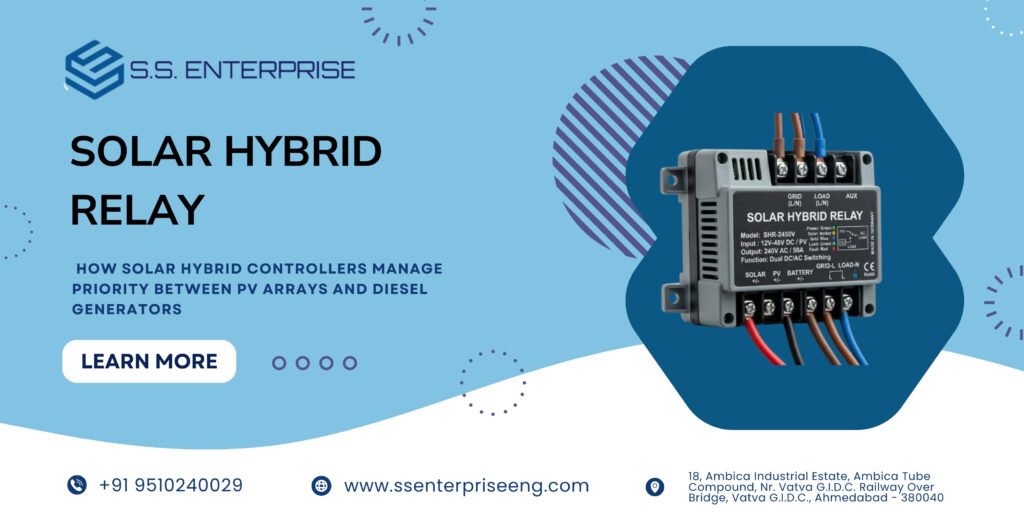
Integrated safety features are critical in hybrid power installations. A specialized Solar Hybrid Relay monitors critical parameters such as bus frequency, reverse power flow, and voltage limits. If an anomaly occurs, the relay isolates the solar inverter from the generator bus instantly, protecting sensitive switchgear from damage.
For industrial plants looking to slash operating expenses while maintaining 100% reliable backup power, integrating an advanced Solar Hybrid Controller into your switchgear is an essential upgrade.
4. Best Practices for Panel Builders
Scalable Architecture: Design your hybrid switchgear panels to accommodate future expansion of battery energy storage systems (BESS) or additional PV strings.
Robust Integration: Ensure your control systems are housed in rugged enclosures designed for industrial environments. Explore our custom-engineered Power Control Panels to see how modern renewable controllers are integrated seamlessly.
Summary
Solar hybrid controllers provide the intelligent logic needed to blend renewable solar energy with diesel backup safely and efficiently. By optimizing fuel priority and protecting system stability, these controllers drive long-term cost savings for modern industries.
Explore our advanced eco-efficient Solar Hybrid Controller and Solar Hybrid Relay options built for modern industrial power systems.