
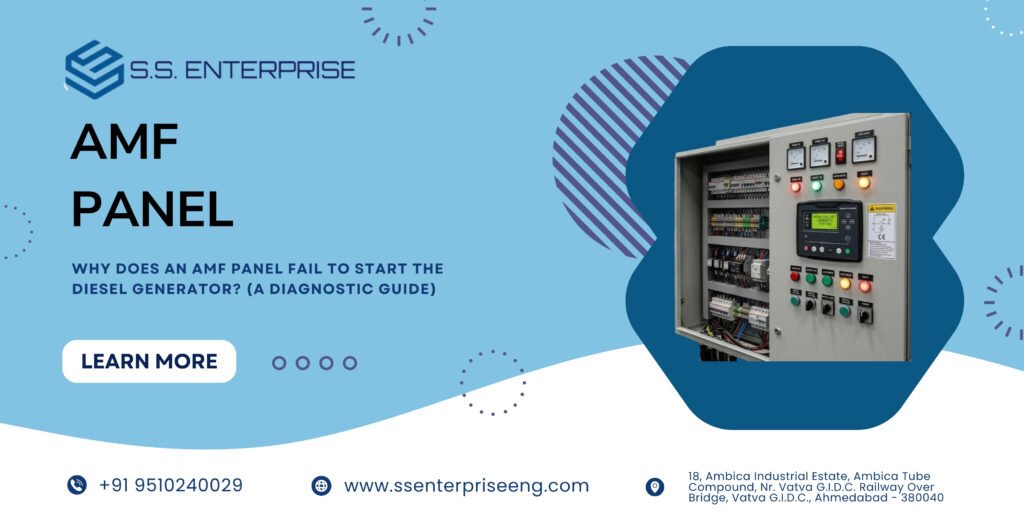
When utility power fails, an Automatic Mains Failure (AMF) panel is expected to spring into action instantly—sensing the outage, cranking the diesel generator, and transferring the load without human intervention.
When that process stalls and the generator fails to start, it creates an immediate emergency for industrial plants, commercial buildings, and critical facilities. Understanding why an AMF panel fails to initiate cranking helps maintenance teams resolve issues quickly and restore reliable backup power.
1. The Core Workflow of an AMF Panel
To troubleshoot a failure effectively, it helps to understand what the AMF system is supposed to do during a grid failure:
Mains Monitoring: The internal controller continuously monitors utility voltage and frequency.
Signal Trigger: Upon detecting a voltage drop or phase failure, the controller initiates a pre-set timer.
Crank Command: If the timer expires and power has not returned, the controller sends a DC signal to the starter motor and fuel solenoid.
Load Transfer: Once the engine reaches rated RPM and stable voltage, the motorized changeover or ATS switches the load to the generator.
A breakdown anywhere in this chain will prevent the generator from starting.
2. Common Causes of AMF Starting Failures
A. Control Battery Voltage Drop
The Root Cause: The single most common reason an AMF panel fails to crank the generator is a weak or dead starting/control battery. Even if the battery has enough surface charge to power indicator lights, it may drop below the required threshold under the heavy cranking load of the starter motor.
Diagnostic Step: Check battery terminal voltage under load using a multimeter. Ensure battery charger circuits inside the panel are functioning correctly.
B. Faulty Auxiliary Relays or Starter Solenoid Signals
The Root Cause: The AMF controller sends a low-current start signal, but the intermediate control relay or starter solenoid fails to pass the heavy DC current required by the starter motor.
Diagnostic Step: Listen for an audible “click” inside the panel when a manual start command is given. If the relay clicks but the starter doesn’t engage, inspect the wiring harness, fuses, and relay contacts for carbon buildup or loose terminals.
C. Fuel Solenoid and Actuator Issues
The Root Cause: The engine cranks smoothly, but it never fires up because the fuel shutoff solenoid fails to open, starving the engine of diesel fuel.
Diagnostic Step: Verify that 12V/24V power reaches the fuel solenoid terminal during the cranking cycle. Check for mechanical sticking in the fuel rack linkage.
D. Misconfigured Controller Settings or Emergency Stop Lockouts
The Root Cause: Accidental tripping of a hardwired emergency stop button, or a corrupted parameter file in the controller logic, will block the start sequence entirely.
Diagnostic Step: Inspect the physical emergency stop push button on the panel door to ensure it is released. Check the AMF controller screen for active lockout alarms.
3. Best Practices to Ensure 100% AMF Panel Reliability
Routine Auto-Test Cycles: Program your AMF controller to run a weekly or monthly no-load test cycle. This ensures the battery stays charged, fuel lines remain primed, and mechanical components operate smoothly.
Clean Component Connections: Industrial vibrations can loosen control wiring over time. Inspect terminal blocks and relay sockets periodically inside your Power Control Panels.
Robust Design Standards: Partner with experienced builders to ensure your backup infrastructure is built using top-tier switchgear components.
Summary
Quickly isolating battery faults, relay issues, or fuel solenoid triggers prevents prolonged power interruptions during grid failures. Regular preventive testing keeps your automated backup systems ready for action.
Explore our robustly engineered AMF Panel configurations built for high-reliability industrial power backup.