
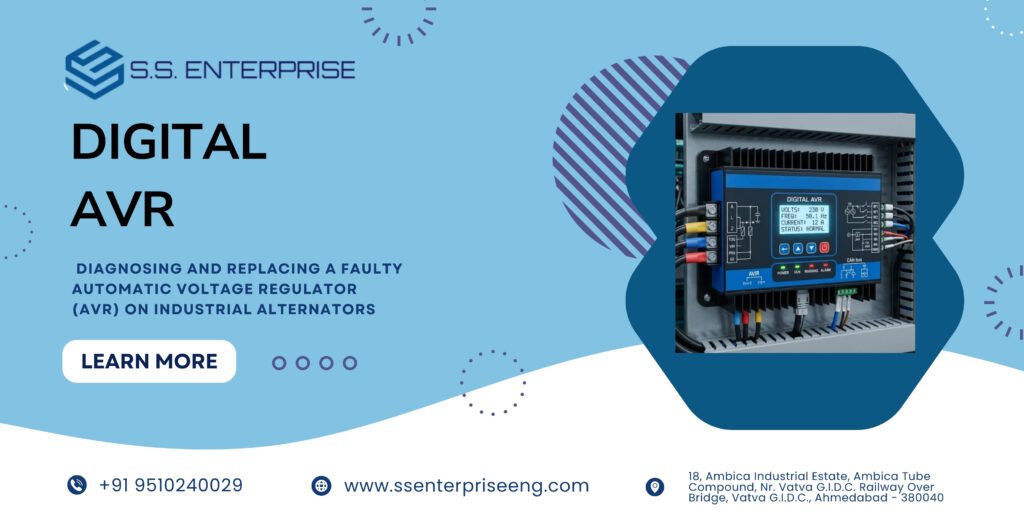
The Automatic Voltage Regulator (AVR) is the nerve center of any diesel generator’s excitation system. Its primary job is to monitor alternator output voltage and adjust exciter field current dynamically, ensuring that voltage remains steady regardless of shifting industrial loads.
When an AVR begins to fail, it compromises the entire electrical network. Sensitive machinery, control panels, and automation equipment connected to the system can suffer erratic power spikes or brownouts. Knowing how to spot the early warning signs of a failing AVR—and knowing how to replace it correctly—is essential for any plant maintenance team.
1. Five Key Signs of a Failing Automatic Voltage Regulator
Before tearing down an alternator or assuming the main winding is damaged, look for these common indicators of AVR failure:
Voltage Hunting (Oscillation): The voltmeter needle or digital display constantly swings up and down (e.g., fluctuating between 380V and 430V) without stabilizing.
Sudden Voltage Collapse: The generator runs at rated RPM, but terminal voltage drops to near zero or only residual voltage (around 10V–20V) is present.
Over-Excitation Trips: The AVR loses its sensing capability, over-exciting the field winding and triggering high-voltage protection shutdowns.
Burnt Smell or Visual Damage: Scorched circuit board components, melted resin, or puffed capacitors usually point to thermal overload or internal short circuits.
Failure to Build Up Voltage: Upon startup, the alternator fails to flash the field and establish nominal voltage.
2. Step-by-Step Diagnostic Procedure
If you suspect an AVR failure, follow these diagnostic checks before purchasing a replacement:
Step 1: Check Residual Voltage
Disconnect the wires from the AVR output terminals (F+ and F-) and start the generator. Measure the AC voltage across the main stator leads and the DC residual voltage coming directly from the exciter stator. If residual voltage is completely absent, the rotating diodes or exciter field may need flashing rather than a new AVR.
Step 2: Inspect Sensing Wires and Fuses
Verify that the voltage sensing leads connected to the AVR are secure, clean, and free of corrosion. Check any inline fuses mounted on the AVR board; a blown fuse is often a symptom of an underlying short circuit in the wiring harness.
Step 3: Test Under Controlled Load
If voltage holds steady at no-load but collapses immediately when an industrial load is applied, the AVR may be failing to supply adequate boost current, or the sensing transformer could be faulty.
3. Replacing and Configuring a New AVR
When it is time to replace the unit, following a proper installation procedure ensures long-term reliability:
Disconnect Power & Lockout: Ensure the generator is completely shut down, locked out, and tagged out before opening the terminal box.
Match Specifications: Ensure the replacement unit matches your alternator’s excitation amp rating, phase configuration (single or three-phase sensing), and frequency range (50Hz/60Hz). Upgrading from an aging analog unit to a modern Digital AVR provides superior transient response and tighter voltage regulation.
Secure Connections: Fasten all wiring securely to the correct terminals (such as power input, sensing leads, and exciter field). Loose connections cause arcing and premature board failure.
Initial Adjustment: Set the stability and voltage potentiometer pots to factory-recommended baseline positions before starting the generator for calibration.
4. Best Practices for Long-Term Excitation Health
Enclosure Protection: Ensure control box seals and space heaters are functional to prevent moisture and condensation from corroding electronic components during humid seasons.
Harmonic Filtering: Protect your voltage regulation circuits from heavy harmonic feedback generated by variable frequency drives (VFDs) within your Power Distribution Systems.
Summary
Promptly identifying AVR symptoms prevents sudden equipment failure and protects sensitive plant loads. Whether you need traditional analog units or high-precision digital upgrades, installing reliable components guarantees stable power delivery.
Explore our high-performance range of standard Automatic Voltage Regulator and advanced Digital AVR units designed for industrial alternators.