
In any industrial manufacturing plant, commercial facility, or infrastructure project, maintaining continuous power flow is non-negotiable. When utility power fails, the electrical network must transition seamlessly to a standby generator or alternative feeder.
To achieve this, engineers rely on automated switching hardware. Two terms often used interchangeably in switchgear design are ATS (Automatic Transfer Switch) and ATD (Automatic Transfer Device). However, understanding their structural and operational differences is crucial when specifying equipment for heavy industrial loads.
1. Defining ATS vs. ATD: What’s the Difference?
Automatic Transfer Switch (ATS)
An ATS is a complete, self-contained electromechanical or motorized switching system. It combines a power switching mechanism (such as molded case circuit breakers, contactors, or dual motorized switches) with an integrated or attached controller. The ATS monitors source voltages and automatically initiates the physical transfer of the load from the normal (utility) source to the emergency (generator) source.
Automatic Transfer Device (ATD) / Controller
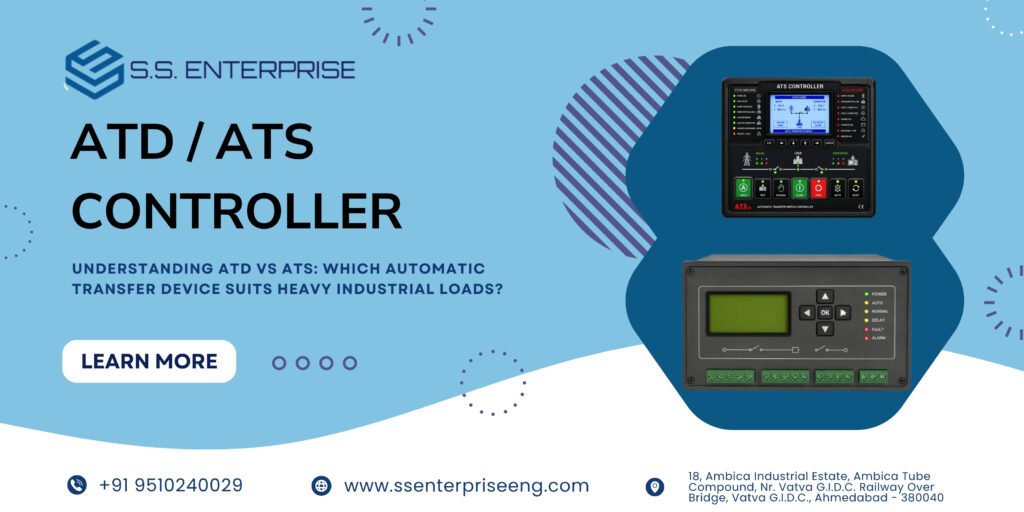
An ATD or specialized ATS controller acts as the intelligent “brain” governing the transfer process. In heavy industrial and high-amperage custom switchgear, the power switching devices (such as heavy-duty motorized air circuit breakers or high-capacity contactors) are physically separate from the controller unit. The ATD monitors parameters, evaluates source availability, and issues precise timing and switching commands to these heavy-duty breakers.
2. Key Factors to Consider for Heavy Industrial Loads
When designing power distribution boards for high-capacity industrial settings, consider how these mechanisms compare across critical performance metrics:
A. Current Carrying Capacity and Short-Circuit Withstand
Standard ATS Units: Many commercial-grade ATS units are pre-packaged as all-in-one enclosures suited for light commercial or moderate loads up to a few hundred amps.
ATD-Controlled Custom Systems: Heavy industrial plants often require massive busbar structures handling thousands of amperes with high fault-withstand ratings. Using an advanced ATD Controller paired with robust motorized Air Circuit Breakers (ACBs) allows panel builders to customize switchgear for heavy-duty short-circuit ratings.
B. Switching Speed and Transition Modes
Open Transition (Break-Before-Make): The normal source disconnects completely before the generator source connects. Ideal for most standard industrial loads.
Closed Transition (Make-Before-Break): For mission-critical facilities where even a momentary micro-interruption is unacceptable, an advanced ATD controller synchronizes the two sources briefly to transfer the load without dropping power, provided phase and frequency match.
C. Mechanical and Electrical Interlocking
Safety is paramount in high-voltage distribution. An intelligent ATS Controller ensures absolute interlocking, preventing the utility and generator breakers from closing simultaneously—which would cause catastrophic short-circuits and arc flashes.
3. Best Practices for Panel Builders and Engineers
Evaluate Load Profiles: Analyze whether your facility requires standard backup or zero-downtime transfer before specifying your changeover hardware.
Integrate with Quality Switchgear: Ensure your transfer mechanisms are housed within rugged, dust-proof enclosures designed for industrial environments. Explore our expertly engineered Power Control Panels to see how reliable transfer systems are built.
Summary
Choosing between an all-in-one ATS setup and an advanced ATD controller depends on your facility’s power capacity, switching speed requirements, and safety standards. Specifying the correct hardware guarantees reliable emergency power transitions.
Enhance your facility’s reliability with our high-performance ATD Controller and ATS Controller systems integrated within robust Power Distribution Systems.